
Start Up Aids to Lauch Calves Toward Succes
It takes hard work and considerable investment to create a newborn calf. So, when that calf hits the ground, we want to do everything we can to give it the best possible start to a healthy and productive life.
There are a number of fundamental steps that we see the best-managed dairies taking to start their calves off right, including:
(1) Colostrum – There’s simply no replacing the life-promoting benefits of high-quality colostrum. It is the foundation of virtually everything else you do to keep your calves healthy and thriving. There is no shortage of helpful information available about managing colostrum. But the most successful operations I see focus on hygienic harvest; measuring and sorting for quality; heat treating to reduce bacteria levels; and feeding 4 quarts within 4 hours of life, followed by another 2 quarts within 12 hours. A dedicated storage freezer and clearly defined protocols for freezing, storing, thawing, and managing frozen colostrum inventories also helps ensure that every calf has high-quality colostrum available.
If a dairy is short on labor, is fighting vertical disease challenges, or does not have ample supplies of excellent colostrum, a high-quality colostrum replacer can be worth the investment.
(2) Transition milk – Current research continues to support the concept that Mother Nature knew all along: that the dam’s milk has unique, beneficial properties that span beyond the first milking of colostrum. While immunoglobulin-G levels drop after the first day of lactation, transition milk still contains valuable proteins, fats, micronutrients, and bioactive compounds that are beneficial to newborn calves, particularly in terms of gut development.
Harvesting good colostrum is challenging, but capturing and feeding transition milk is an even more complex process. Some dairies have mastered that routine, to the distinct benefit of their calves. But there are also ways to affordably and efficiently mimic transition milk. Bravo PD-1TM from Strauss Feeds is an easy-to-use supplement that contains similar ingredients to transition milk, and can be added to milk or milk replacer to ensure calves receive those beneficial ingredients in the first 2 weeks of life.
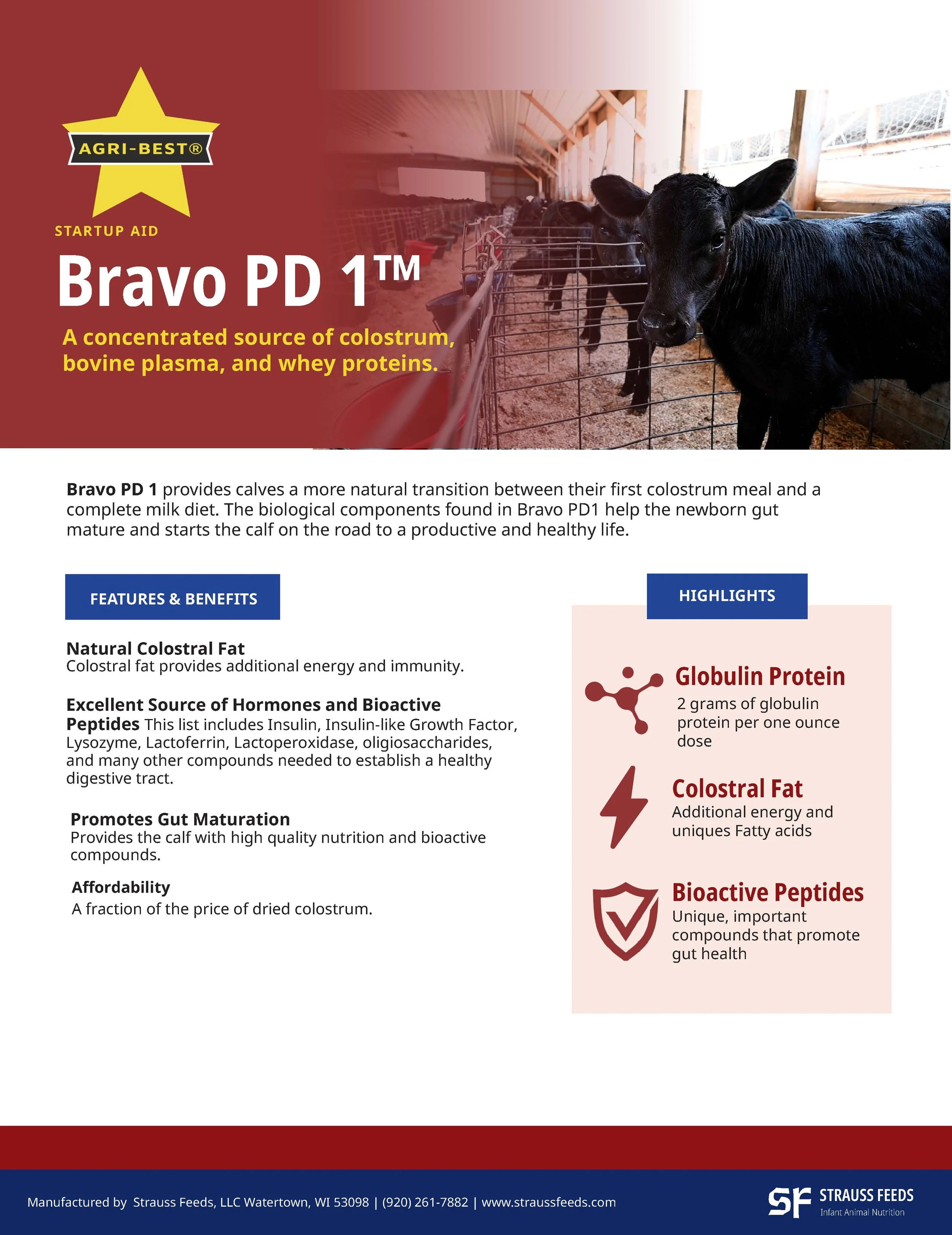
Bravo PD 1
An easy-to-use supplement that contains similar ingredients to transition milk and can be added to milk or milk replacer to ensure calves receive those beneficial ingredients in the first 2 weeks of life.
(3) Navel dips – A fresh navel provides a straight road to the calf’s liver, and if bacteria invade, it can be a speedy trip with a tragic outcome. Anyone who has ever seen a severe navel infection knows it is a stubborn and injurious setback for a newborn calf. Dipping the navels of newborns in 7% tincture of iodine within an hour of birth will go a long way toward preventing infection.
Dipping is preferred to spraying because it ensures that the entire navel is immersed in the iodine solution. Be sure to get the whole navel covered, up to the abdominal wall. Increasingly, dairies are dipping navels with single-use, disposable paper cups versus reusable dippers to prevent harboring and transferring bacteria.
Current regulations are making it more difficult to purchase 7% iodine. If it is not available, a 2% chlorhexidine solution is an alternative. Do not substitute iodine-based teat dips. Remember that they are formulated to keep teat skin moist and supple, while you want a navel dip to dry out the tissue.
(4) Vitamin and mineral boosts – Many dairies administer an injectable dose of BO-SE® (selenium plus vitamin E) to prevent white muscle disease in newborn calves. Some also deliver a vitamin/trace mineral supplement to improve potential deficits that may be present at birth. Your veterinarian or nutritionist can advise the best approach for vitamin and/or mineral supplementation in your herd.
(5) Oral supplements – There are many gel-based products on the market that are administered orally via a syringe on the first day of life. They may contain probiotics, prebiotics, amino acids, functional proteins, vitamins, and/or minerals. Manufacturers promote their potential for boosting the immune system, jump starting gut health, and helping calves navigate stress.
(6) Early life vaccinations – Many dairies also use oral scours vaccinations immediately after birth to support digestive health. These products have been around for many years, and may help protect calves against scours-causing organisms like rotavirus and coronavirus. Intranasal vaccines given at 1-3 days of age may help build immunity to respiratory-disease-causing bacteria and viruses, and some scours organisms.
Collaborate with your veterinarian to choose the products and protocols that best suit your operation. Once those decisions are made, train every calf caretaker on the farm to ensure they are implemented correctly and consistently to start every calf on the path to its best life.
RECENT POSTS


It takes hard work and considerable investment to create a newborn calf. So, when that calf hits the ground, we want to do everything we can to give it the best possible start to a healthy and productive life.